France
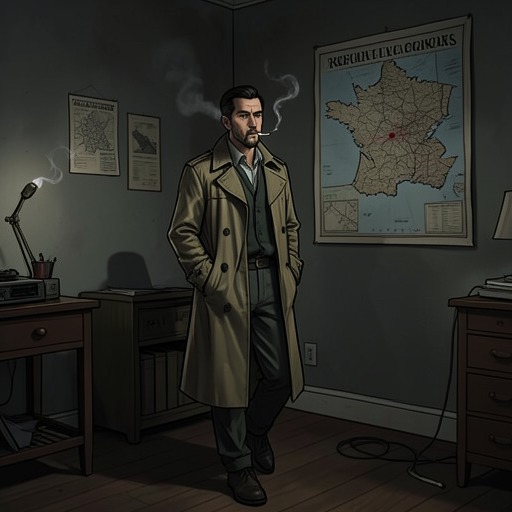
The Day of the JackalFrance is the setting in which a political rupture becomes an underground war and then a nationwide hunt. Its recent conflict over Algeria shapes the OAS’s hostility to Charles de Gaulle; its police and intelligence institutions supply Claude Lebel with an unprecedented investigative apparatus; and its ordinary records and border procedures both reveal the Jackal’s movements and delay the response. The country is not merely a backdrop: its competing loyalties, administrative scale, and public routines determine how the pursuit unfolds.
Political ground of the conflict
The crisis begins with the fate of Algeria and the meaning of France itself. When Charles de Gaulle returned to power in 1958 and established the Fifth Republic, Marc Rodin initially believed that the new government would preserve French rule in Algeria. The words Algérie française seemed to promise the policy he wanted. As de Gaulle’s actions instead pointed toward negotiation and an end to French rule, Rodin’s confidence collapsed into hatred of the President and the political system he represented. The conflict in France therefore grows from a political reversal: what Rodin had taken as a pledge became, in his eyes, a betrayal.
Rodin led most of his battalion into the April 1961 putsch. After the mutiny failed, he and the officers, non-commissioned officers, and soldiers who remained with him joined the Secret Army Organisation. The shrinking prospect of retaining Algeria gave the organization a setting and a motive for violence: in the final weeks before the French settlers’ departure, its campaign exacted destruction as a last revenge. The leaders whose identities were known to the Gaullist authorities went into exile, but exile did not end the conflict. Rodin became operations chief in the OAS leadership abroad, combining organizational skill with the practical, calculating approach that made him more than a battlefield fanatic.
An underground war beneath ordinary life
The novel presents France as a country where open civic life and clandestine violence occupy the same ground. The struggle between the OAS and the Gaullist authorities continues beneath the surface of Parisian culture and routine. The account of the period describes a bitter, sadistic underground war, while the plot gives that general conflict a concentrated objective: the OAS considers hiring a professional assassin to kill de Gaulle. Its leaders describe six earlier attempts, with three exposed in planning, one betrayed on the eve of the attempt, and two carried out unsuccessfully. The Jackal’s contract is thus an escalation within an existing campaign, not an isolated act of violence.
The machinery opposing that campaign is extensive. The French External Documentation and Counter-Espionage Service handles intelligence abroad and counter-espionage within France, with areas of responsibility that can overlap. Its Action Service is described as the core of the anti-OAS effort. Based in buildings off Boulevard Mortier, it deploys men trained in small arms, unarmed combat, communications, demolition, sabotage, interrogation, kidnapping, arson, and assassination. This account gives the French state’s response a physical and institutional dimension: the conflict is fought not only through political decisions, but through specialized organizations trained for clandestine action.
Police records and investigative capacity
The hunt for the assassin brings another layer of French institutions into focus. After hearing the Interior Minister’s briefing, Lebel receives a directive rather than a request: he is to have an office, access to necessary information, the resources of the assembled departments, and no limit on costs. He responds by turning the office into a working command post. His arrangements include a private assistant, a camp bed, washing and shaving supplies, coffee, and ten outside telephone lines with an operator permanently available. The improvised domestic details mark the change from ordinary police work to a sustained national emergency.
Lebel also makes the investigation international from its first hours. He arranges private calls through Interpol to homicide chiefs or deputies in seven countries, asking whether their files contain a political contract killer with successful assassinations behind him. He does not initially have a name, only a poor description and the inference that the intended target must be someone of exceptional importance. The method is deliberately cautious: the request is presented as a tip-off rather than a formal cross-border investigation, because the authorities do not yet know whether the plot has advanced to preparation.
Within France, the records system is both formidable and revealing of the limits of scale. The Renseignements généraux archives contain four and a half million personal dossiers, indexed along five and a half miles of shelves. The files include not only convicted people, but suspects, witnesses, and people acquitted in court. Fingerprint collections and millions of border disembarkation and hotel cards add further ways to trace a person who has entered the country. The records are not computerized, yet archivists can retrieve obscure material quickly. That capacity makes the Jackal’s assumed identities vulnerable to documentary traces—but only when investigators know which name, date, or journey to search for.
A nationwide hunt, slowed by routine
Once the name Charles Calthrop reaches the Interior Ministry, the authorities agree to search France discreetly. Records offices can check for border and hotel cards; the Paris police can examine their own registrations; and border posts, harbours, and airfields can be instructed to hold a person matching the description. Yet the name proves insufficient. The Jackal’s use of another identity forces the investigators to search again, and an archive card eventually shows Alexander James Quentin Duggan entering France by train from Brussels on July 22 and leaving for Brussels on July 31. A hotel card places Duggan near the Place de la Madeleine during that interval. A quiet visit to the hotel proprietor confirms that he was no longer there by August 15.
Later information traces Duggan through several routes without immediately producing an arrest. He spends only five hours in Brussels after arriving from London, then leaves for Milan. A separate report records his entry into France from Italy at Ventimiglia. The crossings and registrations offer a trail, but not a real-time picture of the man’s position. When Duggan is reported at the Hotel du Cerf in Gap, the registration card travels through ordinary channels to regional headquarters before investigators recognize its significance. Lebel explains that secrecy prevented a conspicuous nationwide alert and that the Jackal had already left the hotel before the information reached the national investigation. The delay is not simply a failure of effort: it is a consequence of relying on normal administrative processes while withholding the reason for the search.
Reading the country as evidence
As reports stop arriving under Duggan’s name, Lebel treats absence itself as a clue. The description of a wanted car is circulated quietly, while regional police offices search tens of thousands of hotel cards. No matching registration appears. Lebel distinguishes between two possibilities: the Jackal may still believe himself unsuspected and continue to use his car and identity openly, or he may have abandoned the vehicle and shifted to another identity. Either way, the investigators have to predict what the next ordinary trace would be—a hotel registration, a border crossing, or evidence left with the car.
The discovery that the car was repainted supplies a further inference. If the transformation took place before the drive from Gap toward Ussel, the paint was probably purchased in Gap, suggesting that the Jackal had received a warning about the exposure of his Duggan identity. Lebel cannot identify the source with certainty, but he reasons that the assassin learned of the investigation and chose to continue. The police therefore search outward from the place where the car was found, asking at farmhouses, village shops and cafés, hotels, and woodcutters’ shelters for a tall blond Englishman speaking good French and carrying several pieces of luggage. The inquiry depends on local knowledge as much as national records, and it must be disguised from the press as a search for someone lost after a car accident.
The decisive geographical insight is that the Jackal’s week of apparent inactivity need not mean indecision or retreat. Lebel concludes that the assassin has selected a day and is waiting for the right public occasion. France’s calendar of official engagements becomes as important as its transport routes and police files. At the security cordon, a sentry reports allowing an apparently sick, elderly man through after checking his identity and war-invalid card; the man gave an address on Rue de Rennes. In that brief encounter, the nationwide pursuit narrows to a single passage through a guarded street. France’s institutions have accumulated records across borders and regions, but the immediate test is whether the clues can be read in time to recognize a disguised individual moving among ordinary people.